Tuesday, November 27, 2007

The Cell Membrane


The Cell Membrane


The cell membrane is the barrier that separates the inside of the cell from the outside. The cell membrane is made up of phospholipids,proteins, and other macromolecules. The phosopholipids make up a bilayer. It contains hydrophilic and hydrophobic molecules. The proteins in the cell membrane are located within the phospholipid bilayer. These proteins determine certain funtctions of the cell membrane. There are three types of proteins.


Peripheral Integral Transmembrane
-loosely bound -penetrate lipid bilayer -transport proteins

-on the surface of the cell -across entire membrane -channels,permeases

-identity markers


Nonpolar amino acids - hyrophobic

polar amino acids - hydrophilic


Antigens are markers of a cell and can tell cells apart. It rejects foreign cells, and lets certain cells enter.


Diffusion - is the movement from high concentration to low ( an easy way of thining of it would be H comes before L in the alphabet). Fats and other lipids can get through the phospholipid bilayer directly by diffusion, other larger molecules such as starch can not get into the cell directly.


Facilitated Diffusion (facilitated=with help, open channel=fast transport). Diffusion of hydrophilic molecules. From High to Low.


Active Transport- diffsuion against concentration. Low to High. ATP is needed.


Osmosis = diffusion of water. High to Low. The survival rate of a cell counts on a balance of water loss and uptake. Determined by amount of solute, and water.
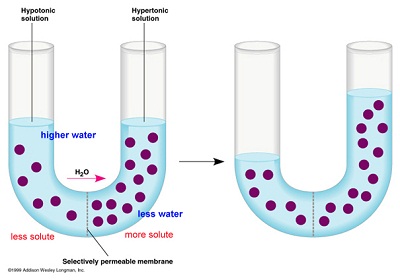


Hypertonic=more solute, and less water.EX-shellfish, plant cells


Hypotonic=less solute, and more water. EX- paramecium


Isotonic=equal solute, and equal water. EX-blood cells in blood


Wednesday, November 21, 2007

Theme 8: SCIENCE, TECHNOLOGY & SOCIETY

Theme 8: SCIENCE, TECHNOLOGY & SOCIETY
Explanation: Scientific research often leads to technological advances that can have positive and/or negative impacts upon society as a whole.
Clarification: You would post here examples of how technological innovations have helped advance science whil ethose technolical accomplishments may have also had either beneficial or deleterious impacts on human society.

Theme 7: INTERDEPENDENCE IN NATURE

Theme 7: INTERDEPENDENCE IN NATURE
Explanation: Living organisms rarely exist alone in nature.
Clarification: You would post here examples of how organisms must interact together to live successfully.

Theme 6: REGULATION

Theme 6: REGULATION
Explanation: Everything from cells to organisms to ecosystems is in a state of dynamic balance that must be controlled by positive or negative feedback mechanisms.
Clarification: You would post here examples of how a dynamic equilibrium is maintained at different levels of life, from homesostatic control of cellular and body conditions to maintenance of population levels in ecosystems.

Theme 5: RELATIONSHIP OF STRUCTURE & FUNCTION

Theme 5: RELATIONSHIP OF STRUCTURE & FUNCTION
Explanation: The structural levels from molecules to organisms ensure successful functioning in all living organisms and living systems.
Clarification: You would post here examples of structure-function relationships in living organisms. How specific molecules, organelles, cells, tissues, organs, and body structures are structured to support the functions that they perform. (Don't forget plants!)

Theme 4: CONTINUITY & CHANGE

Theme 4: CONTINUITY & CHANGE
Explanation: All species tend to maintain themselves from generation to generation using the same genetic code. However, there are genetic mechanisms that lead to change over time, or evolution.
Clarification: You would post here examples of how organisms reproduce while maintaining the same genetic information from generation to generation AND also examples of how organisms reproduce while accumulating changes to their genetic information from generation to generation.

Theme 3: ENERGY TRANSFER

Theme 3: ENERGY TRANSFER
Description: Energy is the capacity to do work. All living organisms are active (living) because of their abilities to link energy reactions to the biochemical reactions that take place within their cells.
Clarification: You would post here examples of how organisms are able to capture energy and utilize it to do the work that supports life.